
Monday, February 15, 2010

Pre-Writing Assignment #2


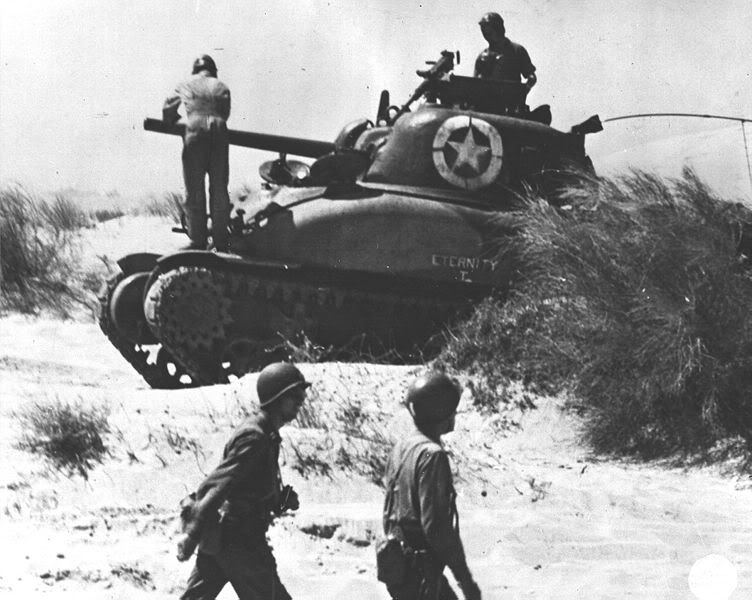
The title for the photograph explicitly tells us the relationship between the seven men. They are soldiers, equal, fighting for one cause. Even though the American is teaching the British soldiers, and thus seems to be the leader, this cannot be assumed. All seven of these men had been through the hell of modern warfare. They had seen the almost invincible Panzer tanks barreling toward them. They had seen their friends die in the deathtraps that were early Allied tanks. They had seen their shells ineffectively bounce off the Panzer’s thick armor. Only when we understand this historical context can even partially begin to understand the relationship these men share. The British are intently listening to the American because they know the information they learn in this crash course could one day save their lives. The American lovingly looks at the shell because he knows it can one day destroy a Panzer before it destroys him.

In analyzing the landscape, keeping to a strict definition will not be extremely beneficial. The landscape of the photograph consists of a flat, sunny desert and a tank. The tank is closer to a person in the photograph (see the analysis above) than an object. Analyzing the broader context of the landscape (i.e. the North African desert), however, is extremely beneficial.

Erwin Rommel, the German commander in Africa, hated the continent. It was hard on machines, men, and supplies. The Allies hated Africa as well for many of the same reasons, but had the added problem that the Germans were very skilled at desert warfare. This information adds a new level of meaning to the picture. Not only are the men in the picture soldiers, they are also desperate. Every man in the picture despises the hot days and cold nights, the sand, the sun, the endless dunes, the Germans, and even sometimes their own commanders. They simply wanted out, and they saw the new generation of tanks as the way to do it. The lighting of the picture also highlights this with the extremely bright sun distorting the image.

This picture does not really have any geography or structural types, especially if we count the tank as a person, as I am doing for this analysis. However, the historical context and the meaning it would have to the original audience is worth mentioning.

When the United States entered the war, the Americans suffered a series of humiliating losses. Outdated equipment, poor leadership, and inexperience plagued the American armies. These new tanks represented a change. This picture would cause a highly patriotic reaction in its original audience. This is especially true because it shows an American teaching British soldiers how to operate machinery. At the time, the British believed the Americans had no right to teach them how to fight a war which Britain had been fighting for over a year.

This photograph has many layers of emotion and feeling. The men show us desperate, determined soldiers. The photographer is intending to stir up patriotic feelings in his audience. Much of the meaning is lost today, but if we put ourselves in the context of the 1940s, we can begin to understand the argument of the photograph.

Wednesday, February 10, 2010

Pre-Writing Assignment #1


This photo, taken in Africa shortly after the United States joined the Allies in World War II, shows an American tank crewman teaching his British counterparts about the new American tanks. While on the surface it seems to be a simple classroom picture, the various technical and emotional aspects of this photo show the enthusiasm of the soldiers, and the importance of the occasion.

The first thing most people will notice when they look at this picture are the vectors of attention. With the exception of the man farthest away from the camera (which we will discuss in a moment), none of the soldiers are looking at the camera. This only makes sense, since the American is teaching the six British tank crewman. What is unexpected, however, is the American’s vector of attention. We might expect it to be looking at his “students,” or at the tank. Instead, he is looking at the shell he is holding. The appeals to logos, pathos and ethos shine through. The photographer is attempting to give us a general ethos of an objective observer. The enthusiasm of the Britains toward the new tank and the enthusiasm of the American for the ammunition give an ethos of expectation. At this point in time, after all, the American tanks were thought to be the best in the world. It seems as though the American is saying, “Now we’ll get ‘em.” Meanwhile, the man farthest from the camera looks directly at the audience. It appears he does not share his comrades’ enthusiasm and is telling the audience, “Remember this; it will change the world.” This, of course, is an appeal to logos. There are more appeals in the vectors of attention, but time dictates that I move on.

Whether intentional or not, the focus of this picture, achieved mainly through lighting and coloration, in not actually foreground. The focus is instead the tank. This could be accidental, since the picture was taken in black and white (which the technology of the day dictated), and the picture was taken in the North African desert. Regardless of the intentionality of the focus, it seems to make the argument that the important thing in modern warfare is not the soldier, but the machinery. It actually took me a little while to notice the teacher at all. He blends into the tank behind him, highlighting the anonymity of modern warfare.

As I stated before, I believe much of the coloration, hue, and lighting of the picture are not meant to make an argument but are instead reflections of period technology and weather. The framing is intentionally simple to avoid the viewer getting distracted from the picture itself.

This picture, while simple in its design and execution, elicits feelings of hope, expectation, and given our historical perspective, a certain measure of despair. The logos, pathos, and ethos of the photo add to that effect. The lighting, coloration, etc, while maybe not intentional, certainly adds to the emotional reaction the viewer feels. World War II was the most dramatic war in history, and this picture gives us a little glimpse of that drama.

Monday, February 8, 2010

Weekly Blog Post 7

I am one of those people who enjoys picking up a digital camera and taking a picture or two. When I read threads on forums about photography, I am usually completely lost after the word “Canon.” In this brief essay, I will explain my interest in, knowledge of, and experience with photography.

I am interested in photography to the point that I wish I owned a digital camera. I enjoy being the “official photographer” for debate tournaments, family vacations, and road trips. Before the age of digital cameras, I always cherished a disposable camera my parents would give me for a class trip or a special occasion. I remember always saving the last shot or two in the film for the “perfect shot.” Most often, the “perfect shot” wound up being a blurry image taken from a car on the way home, but it was the intention that really mattered.

As I hinted at before, my knowledge with photography is at the same time adequate and limited. I do, however, have a decent understanding of the artistry behind it. I can appreciate how the pose, cropping, color, lighting, etc, affect the viewer’s perspective and the intended message of the photograph.

Despite my general knowledge of the messages and art of photography, I have almost no knowledge of the technical aspects of this particular art form. If someone were to ask me what kind of camera my family owns, I would answer something like, “Ummm…a digital one. I think it’s a Canon…” I have never seen or used Photoshop or equivalent program. I have no idea how to saturate color tones, change shutter speed, or even how to turn the flash on and off on some cameras.

In terms of experience, I once again have very little exposure to the art of photography. My brother is somewhat interested in photography, so he has asked me to pose for a few photoshoots. Other than that and a few other candid moments, my experience is mostly “point and shoot” photography for the purpose of remembering a moment. I have never been involved in photography as a fine art.

I both like photography and have little knowledge of it. While I have a basic appreciation and interest in it, that interest is not strong enough for me to become involved in photography beyond its everyday use: documenting for posterity.

Wednesday, February 3, 2010

Weekly Blog Post 6

In this post we will once again delve into Lecrae’s “Don’t Waste Your Life,” this time stepping back and analyzing the overall structure of the video in an attempt to see his appeals to logos to set up pathos and ethos.

Lecrae’s video uses mainly compare and contrast to make his argument. Since the subplot of the robbery of the store has not been explored, we will look more closely at this part of the video.

The storyline of the businessman (Cam) is highly polished and chronological. The robbery is not. The storyline of this subplot also jumps around, beginning first with the one of the robbers running, then cutting to them meeting outside. Lecrae also chooses to film the robbery in a grainy black and white, contrasting that with the clear color of Cam’s story. This contrast adds to the sense of universalism Lecrae is trying to get across. Instead of simply speaking to businessmen or gangsters, the contrasting storylines and filming styles show us that Lecrae believes lives in every culture are wasted.

Lecrae also uses the contrast of words and images to make his argument. While Cam is singing in the hook “Don’t wanna waste my/Don’t wanna waste my life,” two criminals are doing exactly that by robbing a store. As Lecrae is rapping “You don’t see His ways in the days of my life/You can hit my breaks/You can stop my life,” the video is showing Cam and a group of his friends at a party. In other words, the video shows the exact opposite of the words Lecrae is both rapping and writing. As Lecrae and Cam say they don’t want to waste their lives, Cam is doing so through partying and Lecrae is doing so through crime. Thus, the argument essentially made by telling the viewer “what not to do.”

This structure of logos also sets up the pathos and ethos in this song. The contrasting of the words and video sets up an ethos of equal footing. By choosing to portray the main characters themselves, Lecrae and Cam show the audience they are not saints on a level of perfection above their audience. Instead, they are men who were once wasting their lives in pursuit of the things of this world. Not coincidently, the stories portrayed in the video are loosely biographical of Lecrae and Cam. Lecrae grew up in the ghetto and was arrested several times. Cam, on the other hand, had been pursuing money and fame all his life.

The contrasting structure also appeals to pathos, by making the audience sympathetic toward the men wasting their lives. While logos is the main focus of the video, pathos is most certainly present.

Lecrae uses well-structured and contrasting to appeal to logos. He logically and passionately gives his message to all cultures in the world. He begs us to not waste our lives living for futile things, but instead live for Christ.

Monday, February 1, 2010

Weekly Blog Post 5


“That’s why it’s Christ in my rhymes/That’s why it’s Christ all the time/My whole world is built around Him/He’s the life in my lines.”

At this climax of the song, Lecrae changes the nature of the rhetorical appeals used in his music video “Don’t Waste Your Life.” In this short essay, we will examine approximately twenty seconds of the video to see how rhetorical devices are used to communicate the message of the song.

Until this point in the song, Lecrae has mainly used appeals to logos. He has laid out a logical case, using both Scriptural and practical examples, that life is wasted outside of Christ. In the video, Lecrae sets up the story of a wealthy businessman (played by Cam, the singer in the hook) who has received a letter and Bible in the mail. While he is reading the letter (the lyrics of “Don’t Waste Your Life”) some of his friends show up for a party. As his friends are enjoying themselves, the Cam is slowly realizing it is a pointless exercise. It is at this point the climax occurs, and Lecrae switches from logos to pathos to reach his audience.

As Lecrae begins the climax, the video shows Cam in his empty apartment, with only the walls as company. Just seconds before there had been people there. The sense of loneliness and despair this picture paints is overwhelming both for both Cam and the audience.

Meanwhile, Lecrae, “writing” out the lyrics of his song as we sings them, is overcome with the emotion of what he’s saying. His devotion to God and passion for his message causes him to give up writing and simply cry out to God. Until this point, Lecrae has been diligently and logically writing out his arguments. Now, he figuratively throws up his hands in praise. The appeal is obvious: Lecrae desires the audience to have the same devotion he does.

As the camera pans back to Cam, we see he is having the same reaction to the lyrics. He leaves his friends at the party, picks up the Bible, and walks from the room without a word. Again, the implication is that the Word of God should produce an emotional reaction in us driving us to devotion in Christ.

In his video “Don’t Waste Your Life,” Lecrae uses pathos to show his audience the majesty of living for Christ. In the few seconds showing Lecrae praising God and devoting his life to Him, his facial expression and posture plead with the audience to do the same. As Cam gives up the party to read the Bible, Lecrae asks his audience to give up the things of this world for the things of the Lord. Indeed, the implication is that Lecrae shares the vision of Shai Linne when he says, “[God] could give me the Lex, the coup, the Beemer, the Benz/the sex, the loot, the cream or the ends/But next the truth of Jesus, friends, it’s worth nothing.”