Wednesday, March 3, 2010

WP #1 Rough Draft #2

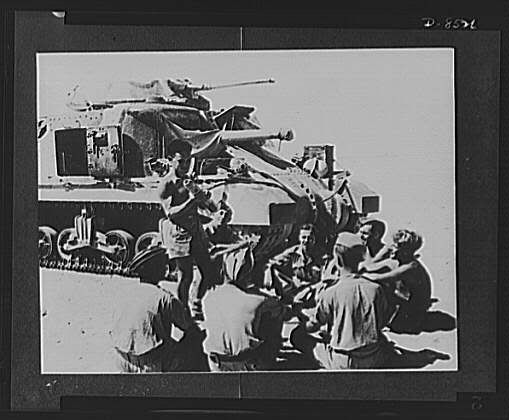
For the first time the United States was involved in a full scale desert war. After the sneak attack on Pearl Harbor, the United States declared war on the Axis powers and moved to invade German North Africa. It was in this environment a wartime photographer took British tank men study U.S. tanks between battle in Egypt. British tank crews in Egypt train for the use of tanks arriving for the U.S.A. Experts on the U.S. machine give impromptu lessons, then the men climb aboard and examine every detail themselves. A gunner giving a talk on the 75mm gun (otherwise known as British tank men).

In order to understand the arguments made in this photograph, it is important to be familiar with its historical context. World War II began in Europe, and it was the first war to utilize the modern tank. The German military swept through Poland, the Netherlands, Belgium, and France in a very short time using a new strategy known as the blitzkrieg (lighting war), in which the Germans used their overpowering Panzer tanks to brush away any resistance. By 1941, this tactic had allowed Germany to annex or conquer all of continental Europe, and the Allies had no answer for the might of the Panzer. This trend continued in North Africa. The allies could not match the power of the German’s tanks. That is where the tank pictured in British tank men, the M3 Lee, came in. It was supposed to be able to match the firepower of its German counterparts. At the time, the M3 was the most powerful land weapon the Allies possessed. Thus, the M3 shown in British tank men would have a strong nationalistic appeal to the American viewer.
British tank men was not meant to be a documentary photograph, but a propaganda photograph used to boost the spirits of American civilians. This can be seen through the pathos and logos generated from the vectors of attention, saturation, and framing, inspiring feelings of nationalism and reflecting the belief of American superiority. However, to the modern viewer, those same technical elements speak of sadness and disappointment.

The first and most important element used by the photographer in British tank men is vectors of attention. When the viewer first sees this photograph, his eyes are immediately drawn to the tank (an M3 Lee), the focal point of the picture. At the time, the unprepared-ness of Pearl Harbor was still very much on the minds of Americans of this period. The M3 was the height of American military might and design. By making this monument to the power of the United States the main focus of the picture, the photograph reminded its original viewers that the US was had the capability to win the war. The state of the military at Pearl Harbor was no longer the case. Through the picturing of the greatest American weapon of war, Americans were reminded of their nation’s might, and inspired to work toward victory.

After the tank, the viewer’s attention is drawn to the actual soldiers in the picture. The vectors of attention of the soldiers are extremely important to the argument this photograph was making to American civilians. The British soldiers in the picture are obviously not looking at the camera, but are instead looking toward their American instructor. By situating the American at the head of the semicircle and showing the British soldiers learning from him, the photograph is once again appealing to the nationalism of Americans. The United States and Britain, despite being allies, had not always worked well together in war. In WWI, the British attempted to dismantle the US Army units shipped to Europe and instead use American soldiers as replacements for fallen British troops. To a lesser extend, British pride showed itself in WWII as well. The British had been fighting the Germans for four years across Europe, while the United States did not join until provoked by Japan. British arrogance did not take long to show itself once again in WWII. The vectors of attention show otherwise, reminding Americans and the world of American ingenuity. It is not the British who are teaching the Americans, but the Americans who are teaching the British how to fight the Germans. The logos of the vectors of attention of the British soldiers appeal to a pathos of nationalism and determination. Yet, while most of the British are looking at the American, one soldier is looking directly at the camera. He seems to be looking at the audience, reminding them the war is very real. This helps to draw the audience into the picture, and even gives the audience a feeling of sympathy for the soldiers. This would reinforce the appeals to Americans’ resolve in “getting the boys home.”


Finally, the American soldier is not shown looking at his students or the tank. He is instead looking at the shell in his hands. He sees that it is the most important thing to both him and his students. They have all most likely seen combat before, and seen the destruction the Panzers could cause. This shell could save his life, destroying the Panzer before the Panzer destroys him. Including this in the picture not only appeals to nationalism, but reminds the American people of the horrors of war. People will die on both sides, but the ingenuity and might (shown through the tank and the shell) of the Allies would win in the end.

This picture was taken in North Africa during spring or summer with a 1940s black and white camera. Therefore, the coloration is slightly altered by the limitations of period technology. However, there are specific elements within British tank men which could not be unintentional. These two purposeful elements are saturation and contrast. The photograph is super-saturated. In fact, it is so saturated that the background appears completely white. Usually, high saturation creates a dreamlike quality. In this case it does not. This creates harsh and sometimes hard to distinguish transitions between the tank, men, and shell. This gives the picture somewhat of a gritty, chaotic feel, creating a sense of chaos and confusion in the viewer. This forces the audience to focus on key objects, such as the tank, soldiers, and shell. Thus, it calms the audience while simultaneously making an argument of nationalism and determination by focusing attention on the objects making the argument.

Finally, British tank men is framed to specifically show a very narrow field of vision. No tank would be alone during wartime, especially “in between battles,” as the picture’s title says. However, the photographer chose to intentionally omit anything but the tank and soldiers. In addition, the field of vision specifically includes the armament and turret of the tank. The framing makes the tank the main focus of the photograph, thus appealing once again to the national pride Americans took in their technological prowess. In addition, the decision to show almost no sky and foreground suggests the surroundings of the photograph were not particularly important. While the picture was taken in the North African desert, the photographer does not want us to focus on the location, but on the soldiers (appealing to determination to win and bring them home) and the tank (sparking a pathos of nationalism).

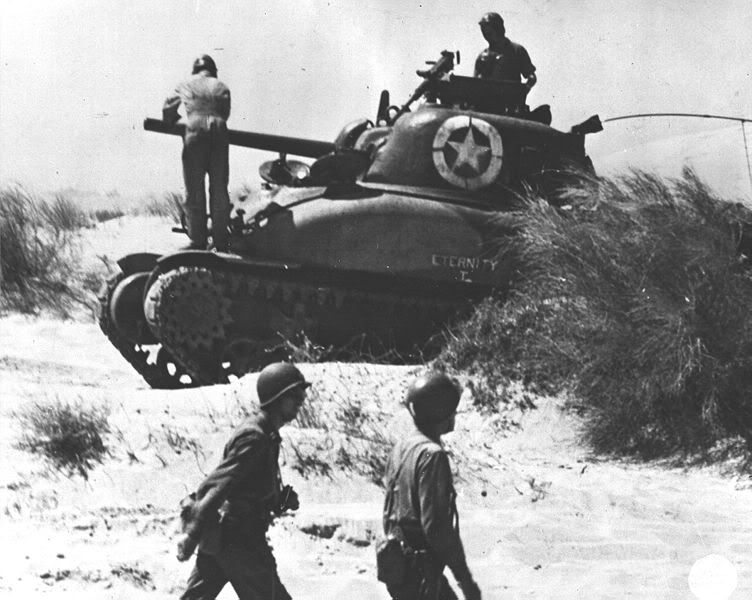
Just as the United States was stunned and united by 9/11, so was the America of 1941 stunned and united by Pearl Harbor. British tank men was a propaganda picture used to inspire Americans to stay committed to the war effort. It was intended to create a sense of national pride, in the same sense pictures of Americans fighting in Afghanistan did after 9/11. However, to the modern viewer, the key elements in British tank men do not inspire pride. Instead, they create a pathos of disappointment. American tanks during WWII were in fact far inferior to German tanks, and the M3 Lee was no exception. Sights such as the picture to the left (an M4 Sherman) were all too common. The shell the American is staring at was fired from a low-velocity canon, which could not pierce the Panzer’s frontal armor. The British were learning how to fight in a moving deathtrap. The tank itself was slow and was an extremely easy target for experienced Panzer gunners. Essentially, the very elements that once inspired patriotism now inspire remind Americans of the death resulting from inferior technology.

In its original context, British tank men gave American civilians a sense of national pride and determination through vectors of attention, saturation, and framing. To the 21st century viewer, the vectors of intention instead inspire a pathos of sadness and mourning. World War II was the largest war in the history of the world, taking more lives than any war in history. Through this one small snapshot of that war, we can see the determination and pride Americans took in their military and country. Regardless of political ideology, the modern American can learn from the pathos shown in British tank men and be reminded that the freedom we enjoy came at a price, and that price is still being paid.

Sunday, February 28, 2010

WP #1 Rough Draft

It was the 9/11 of the 1940s. For the first time since the War of 1812, a foreign power had attacked the homeland of the United States. The economy still had not recovered completely from the Great Depression, and wartime rationing quickly took effect. It was in these conditions a wartime photographer took British tank men study U.S. tanks between battle in Egypt…A gunner giving a talk on the 75mm gun (British tank men).

This photograph makes two distinct arguments, one to the original audience and another to 21st century viewers. To the original viewers of British tank men, the pathos and logos generated from the vectors of attention, saturation, and framing inspired a feeling of nationalism and reflected the belief of American superiority. To the modern viewer, those same technical elements speak of sadness and disappointment.

In order to understand the arguments made in this photograph, it is important to be familiar with its historical context. The German military’s strength was its mobility. It swept through Poland, the Netherlands, Belgium, and France in a very short time using a new strategy known as the blitzkrieg (lighting war). Essentially, the Germans used their overpowering Panzer tanks to brush away any resistance. By 1941, this tactic had allowed Germany to annex or conquer all of continental Europe, and the Allies had no answer for the might of the Panzer. That is where the tank pictured in British tank men, the M3 Lee, came in. It was supposed to be able to match the firepower of its German counterparts.
The first and most important element used by the photographer in British tank men is vectors of attention. When the viewer first sees this photograph, his eyes are immediately drawn to the tank. This is the main focal point of the picture, and the photograph uses the tank (an M3 Lee) to make its main arguments. The M3 was the height of American military innovation and design. By making this monument to the power of the United States the main focus of the picture, the photograph reminded its original viewers that the US was had the capability to win the war. Pearl Harbor was still very much on the minds of Americans of this period. Through the picturing of the greatest American weapon of war, Americans were reminded of their nation’s might, and inspired to work toward victory.

After the tank, the viewer’s attention is drawn to the actual soldiers in the picture. The vectors of attention of the soldiers themselves is extremely important to the argument this photograph was making to American civilians.

The British soldiers in the picture are obviously not looking at the camera. They are instead looking toward their instructor, an American. By situating the American at the head of the semicircle and showing the British soldiers learning from him, the photograph is once again appealing to the nationalism of Americans. The United States and Britain, despite being allies, had not always worked well together in war. In WWI, the British attempted to dismantle the US Army units shipped to Europe and instead use American soldiers as replacements for fallen British troops. To a lesser extend, British pride showed itself in WWII as well. The British had been fighting the Germans for four years across Europe, while the United States did not join until provoked by Japan. British arrogance did not take long to show itself once again in WWII.

The vectors of attention show otherwise, reminding Americans and the world of American ingenuity. It is not the British who are teaching the Americans, but the Americans who are teaching the British how to fight the Germans. The logos of the vectors of attention of the British soldiers appeal to a pathos of nationalism and determination.

Yet, while most of the British are looking at the American, one soldier is looking directly at the camera. He seems to be looking at the audience, reminding them the war is very real. This helps to draw the audience into the picture, and even gives the audience a feeling of sympathy for the soldiers. This would reinforce the appeals to Americans’ resolve in “getting the boys home.”
Finally, the American soldier is not shown looking at his students or the tank. He is instead looking at the shell in his hands. He sees that it is the most important thing to both him and his students. They have all most likely seen combat before, and seen the destruction the Panzers could cause. This shell could save his life, destroying the Panzer before the Panzer destroys him. Including this in the picture not only appeals to nationalism, but reminds the American people of the horrors of war. People will die on both sides, but the ingenuity and might (shown through the tank and the shell) of the Allies would win in the end.

This picture was taken in North Africa during spring or summer with a 1940s black and white camera. Therefore, the coloration is slightly altered by the limitations of period technology. However, there are specific elements within British tank men which could not be unintentional. These two purposeful elements are saturation and contrast.

The photograph is super-saturated. In fact, it is so saturated that the background appears completely white. This creates a surreal, dreamlike pathos, painting an idealized picture of war. Even though things like the shell and tank remind viewers the war will be horrific, it also lets the audience feel some comfort. The dreamlike quality allowed WWII civilians to see the war as far away from American soil. This helped to calm fears about another Pearl Harbor. However, it also creates harsh and sometimes hard to distinguish transitions between the tank, men, and shell. This gives the picture somewhat of a gritty, chaotic feel, creating a sense of chaos and confusion in the viewer. This forces the audience to focus on key objects, such as the tank, soldiers, and shell. Thus, it calms the audience while simultaneously making an argument of nationalism and determination by focusing attention on the objects making the argument.

Finally, British tank men is framed to specifically show a very narrow field of vision. No tank would be alone during wartime, especially “in between battles,” as the picture’s title says. However, the photographer chose to intentionally omit anything but the tank and soldiers. In addition, the field of vision specifically includes the armament and turret of the tank. The framing makes the tank the main focus of the photograph, thus appealing once again to the national pride Americans took in their technological prowess. In addition, the decision to show almost no sky and foreground suggests the surroundings of the photograph were not particularly important. While the picture was taken in the North African desert, the photographer does not want us to focus on the location, but on the soldiers (appealing to determination to win and bring them home) and the tank (sparking a pathos of nationalism).

British tank men was essentially a propaganda picture used to inspire Americans to stay committed to the war effort. It was intended to create a sense of national pride, and it would have in the same sense pictures of American soldiers fighting in Afghanistan did after 9/11. However, to the modern viewer, the key elements in British tank men do not inspire pride. Instead, they create a pathos of disappointment.


American tanks during WWII were in fact far inferior to German tanks, and the M3 Lee was no exception (the tank in the above link is the M4 Sherman, the main US tank during the war). The shell the American is staring at was fired from a low-velocity canon, which could not pierce the Panzer’s frontal armor. The British were learning how to fight in a moving deathtrap. The tank itself was slow and was an extremely easy target for experienced Panzer gunners. Essentially, the very elements that once inspired patriotism now inspire remind Americans of the death resulting from inferior technology.

In its original context, British tank men gave American civilians a sense of national pride and determination through vectors of attention, saturation, and framing. To the 21st century viewer, the vectors of intention instead inspire a pathos of sadness and mourning. World War II was the largest war in the history of the world, taking more lives than any war in history. Through this one small snapshot of that war, we can see the determination and pride Americans took in their military and country.

Sunday, February 21, 2010

WP#1 Purpose Statement

The overall purpose this writing project is to analyze arguments made by the photographer in the picture British tank men study U.S. tanks between battle in Egypt... A gunner giving a talk on the 75mm gun. (From this point forward to be referred to as British tank men.) In order to achieve this purpose, I will first explain and analyze the historical context of the photograph, operating on the assumption it was taken sometime in 1942. This is the most logical date, given the history of the M3 Lee and the fighting in North Africa.

In order to understand the argument of the photograph, I will be analyzing the appeals pathos and logos made in British tank men. To do this, I will examine at several elements within the photograph, all the while keeping the original audience in mind. Through this examination, my goal is to show the audience the extreme feelings of nationalism and determination the original audience would have felt.

The first technical element that will be examined is the significance of the vectors of attention. The photographer was making a specific argument when he decided the British crew should be looking at the American, and the American should be looking at the shell. For the purposes of the analysis, I will also be considering the tank as a person rather than an inanimate object, since way the tank is situated and its position in the picture are also significant. Through relating the historical context, my goal in analyzing vectors of attention is to show the audience how symbolic the vectors would be to WWII civilians.


The second technical element I will examine is the coloration. This includes, but is not necessarily limited to, saturation, hue, and brightness. While there are certain limitations in this analysis due to period technology, the photographer was certainly making an argument when he made the background pure white and exaggerated the shadows on the tank and men.

In addition to examining the original argument of British tank men, I will examine the emotions and feelings in invokes in the 21st century viewer. Because of the historical context and the general failure of the M4 (and thus, American tanks in general), photographs such as these invoke very different emotions to us than the original viewers. Instead of the original audience’s pride, we feel a deep sorrow for the needless deaths caused by inferior technology. I will examine these unintended arguments that are in many cases opposite of what the photographer intended.

Since this paper will be posted on a blog, the general audience could be anyone in the English-speaking world. However, my primary audience is my professor and classmates. Because this paper is for an assignment at a university, it will employ a professional, non-conversational tone. However, since it is possible for almost anyone to view the paper, it will also be written is such a way that is accessible to anyone who has not read Compose, Design, Advocate. Key terms used in the paper will be briefly defined very few assumptions will be made about the audience’s knowledge and background.

The success of this writing project will be determined by the reaction of the viewer after reading it. If the reader reads the paper and understands the arguments made to both the original viewers and the modern viewer and how the technical elements of the photograph support those arguments, then success has been achieved. If the reader does not leave with such an understanding, the paper may be considered a failure.

My largest concern about this project is being too detailed in the historical context. As a student of history, it is very easy for me to get “carried away” and provide too much or unrelated information. This is a concern especially because of the rather limiting word count maximum.

Writing Project #1 will be a challenge for me. Since I have never analyzed photography before, it is something I am not very comfortable with. However, if I explain to my audience how the historical context, vectors of attention, and technical elements work together in British tank men to create cohesive arguments, this project may be considered a success.

Wednesday, February 17, 2010

Pre-Writing Assignment #3

As is most likely obvious from my previous posts, I enjoy studying World War II. Unfortunately, most of my knowledge is of the fighting on the European mainland, which occurred two years after this photograph was taken. Thus, I got a few details wrong; such as the most likely time this picture was taken. This new information changes some aspects of the argument this photograph is making.

It is unfortunately necessary to make much of this post a history lesson. War is a continuum of troop and civilian morale. In order to understand the intended argument of a photograph, we must first understand what soldiers and civilians of the time were feeling.

The tank pictured is an M3 Lee (otherwise known as the M3 Grant). A better picture of the tank itself is included in this post.

Unfortunately, the exact date is not given for the photograph. In fact, the website states it was taken between 1940 and 1946. Given the historical context of the M3 (which was quickly phased out for the M4 Sherman) and teaching British soldiers how to use it, we can assume it was taken early in the war—probably 1942.

At the time, the M3 was the most advanced tank the Allies had developed. The British tanks were inferior to those of the Germans. (militaryfactory.com) This would have been a major source of national pride to Americans. The United States was the newcomer to the war, and its military technology had already eclipsed that of the British. This picture is a testament to that American ingenuity. It demonstrates that, while the Americans may be late, they are still superior to the British and have something to offer in this war.

As mentioned in an earlier post, this picture also attempts to strengthen the American resolve in the war effort. The armies of the United States had already seen action against the Vichy French and had been met with incredible success. The defeats mentioned in previous posts would come in 1943. This picture, with the confident countenance of the American teacher, shows the American public and troops that the Americans could indeed win the war.

As stated before, many of the “decisions” such as lighting and contrast are simply products of period technology. However, it seems difficult for the background to be completely white on accident. Given the historical context, the photographer could have been making the argument that, no matter where the two sides clashed, the M3 and the Allies would be victorious.

Because of the relative danger of operation Shermans, American WW2 tanks are known today as deathtraps. (Hawks) We see death and dying whenever we see an American tank from the period. This view is unchanged by the exact date of a photograph or the make of a tank. Even though we see death, the viewers of the time saw hope. This can be plainly seen when we examine the historical context of the photograph.

Works Cited:

Staff Writer, miliartyfactory.com, "Medium Tank, M3 (Lee / Grant)", (c) 2003-2010

"A Brief History of WWII: North Africa", Worldwariihistory.info, adapted from "A Brief History of the U.S. Army in World War II" by the U.S. Army Center for Military History.

Hawks, Chuck, chuckhawks.com, "The Best Army Tanks of World War II"

Monday, February 15, 2010

Pre-Writing Assignment #2


The title for the photograph explicitly tells us the relationship between the seven men. They are soldiers, equal, fighting for one cause. Even though the American is teaching the British soldiers, and thus seems to be the leader, this cannot be assumed. All seven of these men had been through the hell of modern warfare. They had seen the almost invincible Panzer tanks barreling toward them. They had seen their friends die in the deathtraps that were early Allied tanks. They had seen their shells ineffectively bounce off the Panzer’s thick armor. Only when we understand this historical context can even partially begin to understand the relationship these men share. The British are intently listening to the American because they know the information they learn in this crash course could one day save their lives. The American lovingly looks at the shell because he knows it can one day destroy a Panzer before it destroys him.

In analyzing the landscape, keeping to a strict definition will not be extremely beneficial. The landscape of the photograph consists of a flat, sunny desert and a tank. The tank is closer to a person in the photograph (see the analysis above) than an object. Analyzing the broader context of the landscape (i.e. the North African desert), however, is extremely beneficial.

Erwin Rommel, the German commander in Africa, hated the continent. It was hard on machines, men, and supplies. The Allies hated Africa as well for many of the same reasons, but had the added problem that the Germans were very skilled at desert warfare. This information adds a new level of meaning to the picture. Not only are the men in the picture soldiers, they are also desperate. Every man in the picture despises the hot days and cold nights, the sand, the sun, the endless dunes, the Germans, and even sometimes their own commanders. They simply wanted out, and they saw the new generation of tanks as the way to do it. The lighting of the picture also highlights this with the extremely bright sun distorting the image.

This picture does not really have any geography or structural types, especially if we count the tank as a person, as I am doing for this analysis. However, the historical context and the meaning it would have to the original audience is worth mentioning.

When the United States entered the war, the Americans suffered a series of humiliating losses. Outdated equipment, poor leadership, and inexperience plagued the American armies. These new tanks represented a change. This picture would cause a highly patriotic reaction in its original audience. This is especially true because it shows an American teaching British soldiers how to operate machinery. At the time, the British believed the Americans had no right to teach them how to fight a war which Britain had been fighting for over a year.

This photograph has many layers of emotion and feeling. The men show us desperate, determined soldiers. The photographer is intending to stir up patriotic feelings in his audience. Much of the meaning is lost today, but if we put ourselves in the context of the 1940s, we can begin to understand the argument of the photograph.