Wednesday, March 31, 2010

WP#2 Rough Draft 2

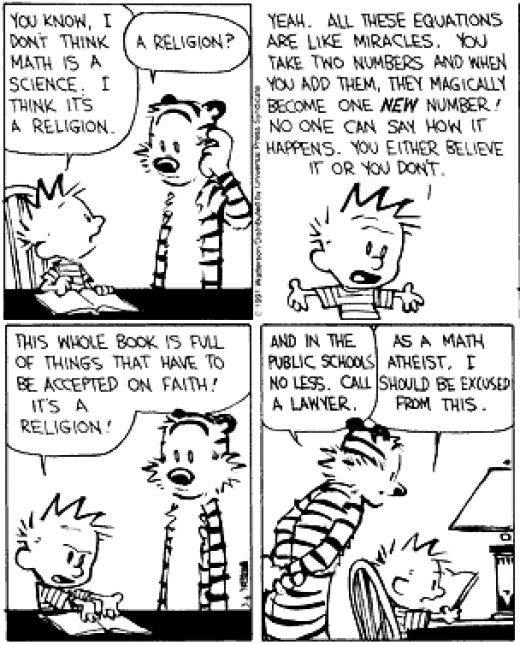
Every teacher and student knows (and probably uses) the excuses. “My dog ate my homework.” “I got sick, but then I was better when I woke up, so my mom made me come to school.” Or, the most common in the 21st century, “My computer crashed.” Every child wants to avoid homework. It is a natural part of life to want to avoid work as much as possible. This strip of Calvin and Hobbes, known to fans as “Math Atheist,” is a parody of childhood laziness and a parent’s sarcastic response. The argument made is simple. Kids will be kids; adults will be adults. Through devices such as anthropomorphism, simplicity, and rhetoric “Math Atheist” presents us with universal appeals to logos which eventually get turned into the expected appeals to pathos.

Calvin and Hobbes was one of the most popular comic strips of the late 1980s and early 1990s. It appeared in thousands of newspapers across the nation and was read by millions. It has remained popular to this day through re-prints and book collections. In other words, almost everyone knows what the strip Calvin and Hobbes is and understands it is supposed to be a funny, sarcastic newspaper comic strip. Thus, the audience comes to “Math Atheist” with a certain set of expectations. It is supposed to funny, an expectation which Bill Watterson, the artist, understands. In “Math Atheist,” however, those expectations are not fulfilled until the very last panel.

The rhetoric of “Math Atheist” makes the main argument, while the various technical elements discussed later amplify and universalize this message. The scene starts out simply enough with a boy (Calvin) doing his math homework at his desk. This is a recurring theme in Calvin and Hobbes, and the audience should expect Calvin to simply refuse to do his homework and play outside, as he does so many other times. However, this time Watterson defies the norm of Calvin’s behavior and instead launches into an impassioned, logical (though flawed) speech about how math is a religion. Math is not science but religion, Calvin claims, and there is a math “god” performing miracles. You either believe in math or you don’t. You have to take it by faith, and that makes it a religion. He appears completely convinced of his own position. Through these appeals to logos, “Math Atheist” defies the conventions we have come to expect from Calvin and Hobbes.

In the fourth panel comes the reveal: “As a math atheist, I should be excused from this.” The whole speech and line of reasoning is an excuse to get out of his homework. As one person said when he saw this comic, it is “The greatest ‘my dog ate my homework’ of all time.” He has created a preposterous religious system with math as a god and declared himself a math atheist just to get out of doing the math in the first place. Through this, “Math Atheist” uses the logical fallacy of red herring (bringing up unrelated issues in order to distract the opposition from the topic at hand) in order to create the argument of the piece. In other words, Watterson intentionally used flawed logic and false appeals to logos in order to set up his parody of little children and his overall appeal to pathos.

Also important to the argument of “Math Atheist” is the tiger’s (Hobbes) response to the speech. The sarcastic comment about getting a lawyer with Hobbes’ neutral (rather than convinced) facial expression gives Hobbes the role of parent. Throughout the years Watterson wrote Calvin and Hobbes, Hobbes always played the role of sensible counterpart to Calvin’s antics. As Calvin’s role is parodying a child’s avoiding homework, Hobbes is parodying a parent’s role in the situation. While it may appear Hobbes is agreeing with Calvin, a close examination of Hobbes’ facial expression (when compared to his facial expressions in other strips), it becomes clear Hobbes is actually saying Calvin’s argument is ridiculous. Hobbes is basically saying, “Yeah right.” “Math Atheist” makes an undeniable argument of parent and child. However, in order for the argument to be universally understood, it must be universally understandable. Several key technical elements universalize and emphasize this argument

First, and most obviously, “Math Atheist” employs anthropomorphism. In short, anthropomorphism is applying human characteristics to animals. It is obvious the tiger (Hobbes) is not a human, yet he talks, thinks, reasons, and understands the concept of separation of church and state just as well as the boy (Calvin) does. “Math Atheist” accomplishes two things by employing this device. First, it forces the audience to suspend disbelief. The audience knows stuffed tigers cannot talk in real life. However, by showing a stuffed tiger doing just that “Math Atheist” forces the audience to put aside its preconceived notions of the world. This allows the audience to accept that a six year old understands the nuances of the separation of church and state. This suspension of disbelief gives the audience accessibility to the subject matter. Second, the use of anthropomorphism gives the audience a way to relate to Calvin and Hobbes. Almost every child had a stuffed animal or doll as a “pet.” Therefore, by using anthropomorphism, "Math Atheist" both allows the audience to both believe the scene and connect with the dialogue.

The second element “Math Atheist” employs is simplicity. Except for the lamp in the fourth frame, there are no extraneous illustrations. Even the chair “disappears” during Calvin’s monologue in the third panel. The table in the foreground in the first panel also has no properties except as a visual “spine” for the panel. This simplicity of artistry gives adds to the universalism of the strip in two ways. First, the lack of “artistic clutter” amplifies the message of the strip. Any extra drawings would serve no purpose than distract the reader from the message. Second, the large empty spaces give the audience a blank slate upon which to write its own interpretation.

In addition to the lack of background and foreground, the characters’ features are drawn very simply. Calvin’s face consists of an incomplete outline, a black spot for his mouth (with a tongue), simple eyes, and lines for his forehead and eyebrows. As Scott McCloud states in The Vocabulary of Comics, “When we abstract an image through cartooning we’re not so much eliminating details as focusing on specific details.” The abstraction of Calvin’s face allows the audience to focus on his emotion and facial expressions. Like a debater passionately arguing his point, Calvin raises his eyebrows as he pleads his case for separation of the math religion and state. Like a distant audience member, Hobbes wears a quizzical expression as Calvin lays a preposterous argument. The simplistic and unrealistic nature of the drawings allow the audience to access and focus on these emotions and amplifies the logos and pathos of “Math Atheist.”

The rhetoric of “Math Atheist” employs an impassioned speech riddled with logical fallacies. This speech has a surprisingly simple conclusion: “I shouldn’t have to do my homework.” Through the sarcastic response of the parent figure, we see the intended argument of a parody of a modern American family. In order to emphasis this argument and make it accessible to the general public, such devises as anthropomorphism and simplicity are used. The end argument is clear and unmistakable: Kids will be kids. And parents will be parents. There is no use in escaping natural human laziness, "Math Atheist" says. The only way to overcome it is to simply accept the fact that work is part of existance.

Tuesday, March 30, 2010

WP#2 Rough Draft

Every teacher and student knows (and probably uses) the excuses. “My dog ate my homework.” “I got sick, but then I was better when I woke up, so my mom made me come to school.” Or, the most common in the 21st century, “My computer crashed.” Every child wants to avoid homework. It is a natural part of life to want to avoid work as much as possible. This strip of Calvin and Hobbes, known to fans as “Math Atheist,” is a celebration and a parody of childhood laziness and a parent’s sarcastic response. Through devices such as anthropomorphism, simplicity, representation, and rhetoric “Math Atheist” presents us with universal appeals to logos which eventually get turned into the expected appeals to pathos.

Calvin and Hobbes was one of the most popular comic strips of the late 1980s and early 1990s. It appeared in thousands of newspapers across the nation and was read by millions. It has remained popular to this day through re-prints and book collections. In other words, almost everyone knows what the strip Calvin and Hobbes is and understands it is supposed to be a funny, sarcastic newspaper comic strip. Thus, the audience comes to “Math Atheist” with a certain set of expectations. It is supposed to funny, an expectation which Bill Watterson, the artist, understands. In “Math Atheist,” however, those expectations are not fulfilled until the very last panel. However, in order for the punch line of the comic to be universally understood, the strip itself has to be universal in appeal.

The rhetoric of “Math Atheist” makes the main argument, while the various technical elements discussed later amplify and universalize this message. The scene starts out simply enough with a boy (Calvin) doing his math homework at his desk. This is a recurring theme in Calvin and Hobbes, and the audience should expect Calvin to simply refuse to do his homework and play outside, as he does so many other times. However, this time Watterson defies the norm of Calvin’s behavior and instead launches into an impassioned, logical (though flawed) speech about how math is a religion. Math is not science but religion, Calvin claims, and there is a math “god” performing miracles. You either believe in math or you don’t. You have to take it by faith, and that makes it a religion. He appears completely convinced of his own position. Through these appeals to logos, “Math Atheist” defies the conventions we have come to expect from Calvin and Hobbes.

In the fourth panel comes the reveal: “As a math atheist, I should be excused from this.” The whole speech and line of reasoning is an excuse to get out of his homework. As one person said when he saw this comic, it is “The greatest ‘my dog ate my homework’ of all time.” He has created a preposterous religious system with math as a god and declared himself a math atheist just to get out of doing the math in the first place. Through this, “Math Atheist” uses the logical fallacy of red herring (bringing up unrelated issues in order to distract the opposition from the topic at hand) in order to create the argument of the piece. In other words, Watterson intentionally used flawed logic and false appeals to logos in order to set up his parody of little children and his overall appeal to pathos.

Also important to the argument of “Math Atheist” is the tiger’s (Hobbes) response to the speech. The sarcastic comment about getting a lawyer with Hobbes’ neutral (rather than convinced) facial expression gives Hobbes the role of parent. Throughout the years Watterson wrote Calvin and Hobbes, Hobbes always played the role of sensible counterpart to Calvin’s antics. While Calvin’s role is parodying a child’s avoiding homework, Hobbes is parodying a parent’s role in the situation. While it may appear Hobbes is agreeing with Calvin, a close examination of Hobbes’ facial expression (when compared to his facial expressions in other strips), it becomes clear Hobbes is actually saying Calvin’s argument is ridiculous. Hobbes is basically saying, “Yeah right.” “Math Atheist” makes an undeniable argument of parent and child, and several key technical elements universalize and emphasize this argument

First, and most obviously, “Math Atheist” employs anthropomorphism. In short, anthropomorphism is applying human characteristics to animals. It is obvious the tiger (Hobbes) is not a human, yet he talks, thinks, reasons, and understands the concept of separation of church and state just as well as the boy (Calvin) does. “Math Atheist” accomplishes two things by employing this device. First, it forces the audience to suspend disbelief. The audience knows stuffed tigers cannot talk in real life. However, by showing a stuffed tiger doing just that “Math Atheist” forces the audience to put aside its preconceived notions of the world. This allows the audience to accept that a six year old understands the nuances of the separation of church and state. This suspension of disbelief gives the audience accessibility to the subject matter. Second, the use of anthropomorphism gives the audience a way to relate to Calvin and Hobbes. Almost every child had a stuffed animal or doll as a “pet.” Using anthropomorphism allows the audience to connect with the dialogue.

The second element “Math Atheist” employs is simplicity. Except for the lamp in the fourth frame, there are no extraneous illustrations. Even the chair “disappears” during Calvin’s monologue in the third panel. The table in the foreground in the first panel also has no properties except as a visual “spine” for the panel. This simplicity of artistry gives adds to the universalism of the strip in two ways. First, the lack of “artistic clutter” amplifies the message of the strip. Any extra drawings would serve no purpose than distract the reader from the message. Second, the large empty spaces give the audience a blank slate upon which to write its own interpretation.

In addition to the lack of background and foreground, the characters’ features are drawn very simply. Calvin’s face consists of an incomplete outline, a black spot for his mouth (with a tongue), simple eyes, and lines for his forehead and eyebrows. As “When we abstract an image through cartooning we’re not so much eliminating details as focusing on specific details.” The abstraction of Calvin’s face allows the audience to focus on his emotion and facial expressions. Like a debater passionately arguing his point, Calvin raises his eyebrows as he pleads his case for separation of the math religion and state. Like a distant audience member, Hobbes wears a quizzical expression as Calvin lays a preposterous argument. The simplistic and unrealistic nature of the drawings allow the audience to access and focus on these emotions and amplifies the logos and pathos of “Math Atheist.”

The rhetoric of “Math Atheist” employs an impassioned speech riddled with logical fallacies. This speech has a surprisingly simple conclusion: “I shouldn’t have to do my homework.” Through the sarcastic response of the parent figure, we see the intended argument of a parody of a modern American family. In order to emphasis this argument and make it accessible to the general public, such devises as anthropomorphism and simplicity are used. The end argument is clear and unmistakable: Kids will be kids. And parents will be parents.

Saturday, March 27, 2010

WP #2 Purpose Statement

The goal of this writing project is to analyze the arguments made in this specific strip of Calvin and Hobbes by Bill Watterson. This strip will be referred to as “Math Atheist.” In order to fulfill this general purpose, I will first include the relevant historic facts regarding the culture of the early 1990s. I will then introduce the two main arguments of “Math Atheist” using specific examples from the text.

The first argument I will analyze is that of convention and experimentation. When “Math Atheist” was printed in newspapers (and mentioned in the previous pre-write), Watterson was struggling against the conventions of comics. He desired to experiment and draw extravagant figures, while the newspapers were forcing him to downsize and simplify his drawings.

In many ways, “Math Atheist” is a mockery of those conventions and mechanics. Except for a lamp in the fourth panel, there are no extra figures or backgrounds of any kind. Even the table, chair, facial expressions, and gestures are minimal. Given the above historical information, “Math Atheist” makes an argument against the mechanics of early 1990s comic writing by following those conventions. Combined with the other themes of Calvin and Hobbes, which often stress nonconformity, this argument is clear and compelling.

The second argument “Math Atheist” makes is in the dialogue. As also is mentioned in the previous pre-write, the public school system in the early 1990s was much more closed-minded to religion than it is today. Through his humorous but pointed dialogue between Calvin and his tiger Hobbes, “Math Atheist” urges the American people to lighten up when it comes to religion in schools. After all, almost everything students learn in school can be traced back to religious roots. Of course, this argument will be expanded upon in the final draft.

The primary audience of this assignment is, of course, my professor and classmates. As such, it will be written in an academic style with a heavy emphasis on logical analysis and historical support. However, since anyone could see the final draft, it will also be understandable to the average reader. Any non-common sense terms will defined and any historical facts will be duly documented.


The success of this paper will be determined by the clarity of my arguments. It is difficult to prove a humorous cartoon is making a serious argument about national policy. Without the historical background, it may also seem a stretch to claim “Math Atheist” is arguing against convention by following the very convention it is speaking against. Therefore, if my audienced is convinced my analysis is correct, and sees that various techniques such as dialogue, typography, framing, artistic complexity, and other conventions, the project may be considered a success. These technical elements will be expanded upon in the final draft, but word constraints prevent me from doing so now.

My concern about this project is projecting my personal opinion onto the project. I strongly agree with the arguments I claim “Math Atheist” is making. Therefore, it would be very easy for me to turn this into an argumentative essay rather than an analysis of “Math Athiest.” I will attempt to overcome this problem by strictly adhering to an analysis, rather than allowing my own conviction interfere with my objective writing.

I am greatly looking forward to WP#2. I have always enjoyed comics, and Calvin and Hobbes is one of my favorite strips. It will definitely be a challenge to put my personal opinion aside, but I am looking forward to the opportunity to analyze one of the most recognized comic strips of the modern era.

Friday, March 19, 2010

Before researching this strip, I knew very little about the separation of church and state in the 1990s and even less about comic strips of the period. Thus, the research I have conducted has changed the initial inferences I made and gave meaning to some of the observations I made. The artwork used in Calvin and Hobbes is a reaction to the culture of comic strips at the time. The satirical cultural argument Watterson makes reflects the attitude in the United States toward religion in schools at the time.

Watterson was not at all pleased with the way newspaper comic strips were being truncated in the early 1990s. This strip, which appeared on March 6, 1991, (gocomics.com) came a mere two months before he took an extended sabbatical from writing. He said the small, rigid panel sizes limit artistry and dialogue. According to Watterson, the panel sizes left no room for anything but the most basic dialogue and artwork. (Watterson, West) This attitude is clearly reflected in this strip. There is no background, simple facial expressions and almost no detail. In fact, the only unneeded artistic element is the lamp shown in the fourth panel. In addition, the dialogue in this strip, while definitely not simplistic, rigidly follows the conventions the public understands. Everything flows from left the right, top to bottom. The typography is typical of humorous comics. Through the simplicity and conventionality of his work, Watterson is making an argument that comics are too simple and should be expanded so artists can include more detail and depth.

Of course, the primary argument of the strip is not the artistry, but the actual dialogue.
Through the dialogue of “Math Atheist,” Watterson is making two arguments, one comical and one serious. First, he makes a comical argument about how children attempt to get out of any kind of schoolwork. In “Math Atheist” Watterson is creating a pathos of humor through a parody of children’s reluctance to learn.

However, the pathos created by the dialogue also makes an appeal to logos. As mentioned before, “Math Atheist” appeared in 1991, when laws governing religion in schools were much more restrictive. For example, in 1990, the Supreme Court ruled in the case of Board of Education of the Westside Community Schools v Mergens it was legal for a Christian student group to exist in the Westside School District in Nebraska. (The Religious Freedom Page) Such groups are now commonplace and exist in many high schools. It was in this relatively restrictive environment that Watterson wrote this strip. Through his ridiculous application of the separation of church and state, Watterson makes an appeal to logos by saying the constant bickering over the separation of church and state has gone too far. “Math Atheist” makes the argument that the American people have become too quick to sue over religion in schools. Hobbes’ suggestion to hire an attorney highlights this argument. Watterson is attempting to show Americans that they are far too quick to cry religion and far too slow to actually learn.

Bill Watterson created a masterpiece when he wrote Calvin and Hobbes. “Math Atheist,” one of his most famous pieces, effectively critiques the convention of comics and American society. At the same time, it manages to follow the very conventions it is speaking against and not sacrifice humor for the message. “Math Atheist” is truly an exceptional specimen of newspaper comic strips.

Works Cited:


Watterson, Bill and West, Richard Samuel "Interview: Bill Watterson," from Comics Journal issue 127, February 1989.

Martens, Nick, "Watterson’s World: Sunday Study Sunday," bygonebureau.com, April 17, 2009.

Wednesday, March 10, 2010


Calvin and Hobbes by Bill Watterson is loved by many as one of the greatest comic strips of all time. The above strip shows why it is so loved. It combines the humor of small children, simplicity of design and satire of current events to create a delightfully funny and yet pointed statement.

In this particular strip, Calvin, a first grader who hates all things educational (except dinosaurs) is attempting to do his math homework. As is his usual habit, he attempts to find a way around it. This time, he decides math is essentially a religion in which addition and subtraction problems constitute miracles. He then explains that he doesn’t believe the “religion” and declares himself a “math atheist.” Hobbes, Calvin’s stuffed tiger that is alive in Calvin’s imagination, is always the sensible one in the strip. As the more logical of the two, he realizes the teaching of the mathematical “religion” in public schools violates the separation of church and state. Thus, the strip is meant to be humorous and still maintain a connection to the readers’ lives.

As with many other comics, one of the first things to catch the viewers’ attention Calvin’s ridiculously big head, relative lack of height, and simply-drawn face and hands ask the viewer to accept the strip as what it is—a fanciful look into the life of a first grader. After all, what first grader understands the concept of religion in school so thoroughly? The same applies to Hobbes. This strip doesn’t show it, but whenever another character is in the frame we see Hobbes as a mute stuffed tiger—as everyone but Calvin sees him. Watterson again expects us to ignore impossibilities for the sake of the humor and satire of the piece. This is also illustrated by the outside-the-lines drawing of Hobbes’ stripes, the fact he is standing erect, and his exaggerated facial features.

The basic mechanics and norms of Calvin and Hobbes are followed pretty strictly. We are not asked to guess which characters are speaking or in what order the characters are speaking. There is also very little ambiguity in what the characters mean or imply. In other words, in the case of mechanics it is a very standard newspaper comic strip.

The typography used in Calvin and Hobbes is very telling to the internal context of the strip. It is written in an all-caps font with errors in mechanics such as slanting (which is most apparent with exclamation points). It also looks very childish, which correlates with the six-year old main character. However, it is serious and readable enough that the audience does not lose the message and most likely will not consciously notice it without reading several strips.
Calvin and Hobbes is a classic among newspaper comic strips. Through simplicity and imagination, yet attention to mechanics of the genre it manages to be both humorous and pointed at the same time. Watterson created a masterpiece in Calvin and Hobbes, and this piece exemplifies that genius.