Saturday, March 27, 2010

WP #2 Purpose Statement

The goal of this writing project is to analyze the arguments made in this specific strip of Calvin and Hobbes by Bill Watterson. This strip will be referred to as “Math Atheist.” In order to fulfill this general purpose, I will first include the relevant historic facts regarding the culture of the early 1990s. I will then introduce the two main arguments of “Math Atheist” using specific examples from the text.

The first argument I will analyze is that of convention and experimentation. When “Math Atheist” was printed in newspapers (and mentioned in the previous pre-write), Watterson was struggling against the conventions of comics. He desired to experiment and draw extravagant figures, while the newspapers were forcing him to downsize and simplify his drawings.

In many ways, “Math Atheist” is a mockery of those conventions and mechanics. Except for a lamp in the fourth panel, there are no extra figures or backgrounds of any kind. Even the table, chair, facial expressions, and gestures are minimal. Given the above historical information, “Math Atheist” makes an argument against the mechanics of early 1990s comic writing by following those conventions. Combined with the other themes of Calvin and Hobbes, which often stress nonconformity, this argument is clear and compelling.

The second argument “Math Atheist” makes is in the dialogue. As also is mentioned in the previous pre-write, the public school system in the early 1990s was much more closed-minded to religion than it is today. Through his humorous but pointed dialogue between Calvin and his tiger Hobbes, “Math Atheist” urges the American people to lighten up when it comes to religion in schools. After all, almost everything students learn in school can be traced back to religious roots. Of course, this argument will be expanded upon in the final draft.

The primary audience of this assignment is, of course, my professor and classmates. As such, it will be written in an academic style with a heavy emphasis on logical analysis and historical support. However, since anyone could see the final draft, it will also be understandable to the average reader. Any non-common sense terms will defined and any historical facts will be duly documented.


The success of this paper will be determined by the clarity of my arguments. It is difficult to prove a humorous cartoon is making a serious argument about national policy. Without the historical background, it may also seem a stretch to claim “Math Atheist” is arguing against convention by following the very convention it is speaking against. Therefore, if my audienced is convinced my analysis is correct, and sees that various techniques such as dialogue, typography, framing, artistic complexity, and other conventions, the project may be considered a success. These technical elements will be expanded upon in the final draft, but word constraints prevent me from doing so now.

My concern about this project is projecting my personal opinion onto the project. I strongly agree with the arguments I claim “Math Atheist” is making. Therefore, it would be very easy for me to turn this into an argumentative essay rather than an analysis of “Math Athiest.” I will attempt to overcome this problem by strictly adhering to an analysis, rather than allowing my own conviction interfere with my objective writing.

I am greatly looking forward to WP#2. I have always enjoyed comics, and Calvin and Hobbes is one of my favorite strips. It will definitely be a challenge to put my personal opinion aside, but I am looking forward to the opportunity to analyze one of the most recognized comic strips of the modern era.

Friday, March 19, 2010

Before researching this strip, I knew very little about the separation of church and state in the 1990s and even less about comic strips of the period. Thus, the research I have conducted has changed the initial inferences I made and gave meaning to some of the observations I made. The artwork used in Calvin and Hobbes is a reaction to the culture of comic strips at the time. The satirical cultural argument Watterson makes reflects the attitude in the United States toward religion in schools at the time.

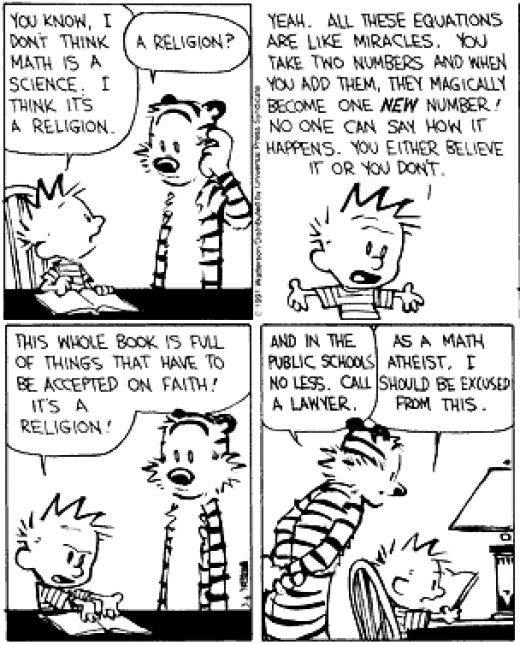
Watterson was not at all pleased with the way newspaper comic strips were being truncated in the early 1990s. This strip, which appeared on March 6, 1991, (gocomics.com) came a mere two months before he took an extended sabbatical from writing. He said the small, rigid panel sizes limit artistry and dialogue. According to Watterson, the panel sizes left no room for anything but the most basic dialogue and artwork. (Watterson, West) This attitude is clearly reflected in this strip. There is no background, simple facial expressions and almost no detail. In fact, the only unneeded artistic element is the lamp shown in the fourth panel. In addition, the dialogue in this strip, while definitely not simplistic, rigidly follows the conventions the public understands. Everything flows from left the right, top to bottom. The typography is typical of humorous comics. Through the simplicity and conventionality of his work, Watterson is making an argument that comics are too simple and should be expanded so artists can include more detail and depth.

Of course, the primary argument of the strip is not the artistry, but the actual dialogue.
Through the dialogue of “Math Atheist,” Watterson is making two arguments, one comical and one serious. First, he makes a comical argument about how children attempt to get out of any kind of schoolwork. In “Math Atheist” Watterson is creating a pathos of humor through a parody of children’s reluctance to learn.

However, the pathos created by the dialogue also makes an appeal to logos. As mentioned before, “Math Atheist” appeared in 1991, when laws governing religion in schools were much more restrictive. For example, in 1990, the Supreme Court ruled in the case of Board of Education of the Westside Community Schools v Mergens it was legal for a Christian student group to exist in the Westside School District in Nebraska. (The Religious Freedom Page) Such groups are now commonplace and exist in many high schools. It was in this relatively restrictive environment that Watterson wrote this strip. Through his ridiculous application of the separation of church and state, Watterson makes an appeal to logos by saying the constant bickering over the separation of church and state has gone too far. “Math Atheist” makes the argument that the American people have become too quick to sue over religion in schools. Hobbes’ suggestion to hire an attorney highlights this argument. Watterson is attempting to show Americans that they are far too quick to cry religion and far too slow to actually learn.

Bill Watterson created a masterpiece when he wrote Calvin and Hobbes. “Math Atheist,” one of his most famous pieces, effectively critiques the convention of comics and American society. At the same time, it manages to follow the very conventions it is speaking against and not sacrifice humor for the message. “Math Atheist” is truly an exceptional specimen of newspaper comic strips.

Works Cited:


Watterson, Bill and West, Richard Samuel "Interview: Bill Watterson," from Comics Journal issue 127, February 1989.

Martens, Nick, "Watterson’s World: Sunday Study Sunday," bygonebureau.com, April 17, 2009.

Wednesday, March 10, 2010


Calvin and Hobbes by Bill Watterson is loved by many as one of the greatest comic strips of all time. The above strip shows why it is so loved. It combines the humor of small children, simplicity of design and satire of current events to create a delightfully funny and yet pointed statement.

In this particular strip, Calvin, a first grader who hates all things educational (except dinosaurs) is attempting to do his math homework. As is his usual habit, he attempts to find a way around it. This time, he decides math is essentially a religion in which addition and subtraction problems constitute miracles. He then explains that he doesn’t believe the “religion” and declares himself a “math atheist.” Hobbes, Calvin’s stuffed tiger that is alive in Calvin’s imagination, is always the sensible one in the strip. As the more logical of the two, he realizes the teaching of the mathematical “religion” in public schools violates the separation of church and state. Thus, the strip is meant to be humorous and still maintain a connection to the readers’ lives.

As with many other comics, one of the first things to catch the viewers’ attention Calvin’s ridiculously big head, relative lack of height, and simply-drawn face and hands ask the viewer to accept the strip as what it is—a fanciful look into the life of a first grader. After all, what first grader understands the concept of religion in school so thoroughly? The same applies to Hobbes. This strip doesn’t show it, but whenever another character is in the frame we see Hobbes as a mute stuffed tiger—as everyone but Calvin sees him. Watterson again expects us to ignore impossibilities for the sake of the humor and satire of the piece. This is also illustrated by the outside-the-lines drawing of Hobbes’ stripes, the fact he is standing erect, and his exaggerated facial features.

The basic mechanics and norms of Calvin and Hobbes are followed pretty strictly. We are not asked to guess which characters are speaking or in what order the characters are speaking. There is also very little ambiguity in what the characters mean or imply. In other words, in the case of mechanics it is a very standard newspaper comic strip.

The typography used in Calvin and Hobbes is very telling to the internal context of the strip. It is written in an all-caps font with errors in mechanics such as slanting (which is most apparent with exclamation points). It also looks very childish, which correlates with the six-year old main character. However, it is serious and readable enough that the audience does not lose the message and most likely will not consciously notice it without reading several strips.
Calvin and Hobbes is a classic among newspaper comic strips. Through simplicity and imagination, yet attention to mechanics of the genre it manages to be both humorous and pointed at the same time. Watterson created a masterpiece in Calvin and Hobbes, and this piece exemplifies that genius.

Saturday, March 6, 2010

WP1: Final Draft

Author's Note:

This assignment was extremely difficult for me in two ways. First, I know next to nothing about photography and analyzing photographs is something completely foreign to me. I was able to overcome this obstacle by studying CDA and practicing analyzing photos in-class. My second challenge was my love of history and previous knowledge of World War II. Because I love history, it would have been very easy for me to change the essay into a history report. Also, because of my previous knowledge, it was very difficult for me to distinguish what was and was not common knowledge. For example, I had a hard time deciding if the blitzkrieg is common knowledge. I overcame the difficulty of my love and knowledge of history first by making sure everything in the essay flowed from the thesis and constantly checking to make sure I was staying on-topic. I also decided to cite every historical fact not taught in elementary school.

The largest change I made while revising was moving the paragraph with the historical context from after the thesis statement to before the thesis. My fear was that moving this paragraph would make the thesis seem irrelevant because the introduction would be too long. However, after moving the paragraph I realized this was not the case.

The second biggest change I made was taking out difficult to prove historical facts and inferences. A specific example of this is the statement, “British arrogance did not take long to show itself once again in WWII.” Since this would be difficult to know for sure, I decided the above sentence should not be in the final draft. I replaced it with the sentence “[The American] experience [with the British in WWI] would have been in the minds of American civilians and officials alike.”

Another change I made was making the paper more historically accurate. Upon doing more research on the subject, I found that some of the statements I made in the rough drafts were not entirely accurate. First, while it is true American tanks were inferior to German tanks in WWII, it turns out the M3 actually matched up relatively well at first. Thus, I removed the sentences talking about the British learning how to pilot a death trap, since the “death traps” were actually the M4s, not the M3s. This forced me to change the paragraph about the modern viewer, emphasizing that the M4 is the best known American tank of the war.

The second historical inaccuracy I found was about Pearl Harbor. Instead of defeatism, the sources I found said the main effect of the attack was not despondency, but enthusiasm and determination. Thus, I changed the argument of my essay from “reminding Americans they could win the war” to “stirring the already existing enthusiasm.”

I also took out the propaganda poster and replaced it with a picture of a tank shell compared to a pistol. I also added hyperlinks to Axis Powers and 9/11. In addition, I made minor changed to things like sentence structure, grammar, etc., but the changes listed above are the largest and most significant.

Rough Draft #1
Rough Draft #2
Statement of Purpose

Final Draft:

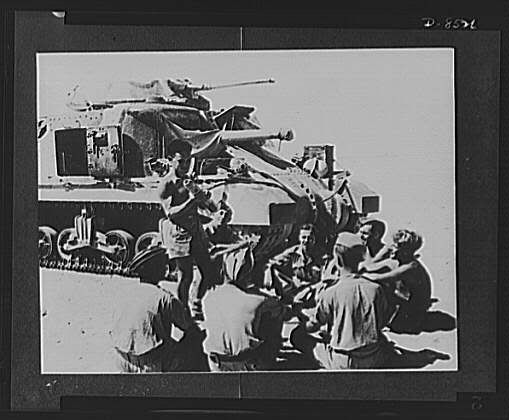
For the first time the United States was involved in a full scale desert war. After the sneak attack on Pearl Harbor, the United States declared war on the Axis powers and moved to invade German North Africa. It was in this environment a wartime photographer took the photo entitled British tank men study U.S. tanks between battle in Egypt. British tank crews in Egypt train for the use of tanks arriving for the U.S.A. Experts on the U.S. machine give impromptu lessons, then the men climb aboard and examine every detail themselves. A gunner giving a talk on the 75mm gun (otherwise known as British tank men).


In order to understand the arguments made in this photograph, it is important to be familiar with its historical context. World War II began in Europe, and it was the first war to utilize the modern tank. The German military swept through Poland, the Netherlands, Belgium, and France in a very short time using a new strategy known is the blitzkrieg (lighting war), using their overpowering Panzer tanks to brush away any resistance. By 1941, this tactic had allowed Germany to annex or conquer all of continental Europe, and the Allies had no answer for the might of the Panzer. (US Memorial Holocaust Museum) This trend continued in North Africa. The allies could not match the power of the German’s tanks. The M3 Lee, the tank pictured in British tank men was supposed to change that.The M3 was the most powerful tank the Allies possessed. (militaryfactory.com) Thus, the M3 shown in British tank men would have a strong nationalistic appeal to the American viewer. After the attacks on Pearly Harbor, the American people were united to defeat their new enemies. (Robinson) British tank men was meant to keep that enthusiasm strong.

British tank men was not meant to be a documentary photograph, but a propaganda photograph used to boost the spirits of American civilians. This can be seen through the pathos and logos generated from the vectors of attention, saturation, and framing, inspiring feelings of nationalism and reflecting the belief of American superiority. To the modern viewer, these same technical elements in British tank men speak of sadness and disappointment.

The first and most important element used by the photographer in British tank men is vectors of attention. When the viewer first sees this photograph, his eyes are immediately drawn to the tank (an M3 Lee), the focal point of the picture. By making this monument to the power of the United States the main focus of the picture, the photograph stirred the patriotism and enthusiasm of the American people. The state of the military at Pearl Harbor was no longer the case. Through the picturing of the greatest American weapon of war, Americans were inspried of their nation’s might, and encouraged to work toward victory.

After the tank, the viewer’s attention is drawn to the actual soldiers in the picture. The vectors of attention of the soldiers are extremely important to the argument this photograph was making to American civilians. The British soldiers in the picture are obviously not looking at the camera, but are instead looking toward their American instructor. By situating the American at the head of the semicircle and showing the British soldiers learning from him, the photograph is once again appealing to the nationalism of Americans. The United States and Britain, despite being allies, had not always worked well together in war. In WWI, the British attempted to dismantle the US Army units shipped to Europe and instead use American soldiers as replacements for fallen British troops. (Hickman, Kennedy) This experience would have been in the minds of American civilians and officials alike. To combat this, the vectors of attention remind Americans and the world of American ingenuity. It is not the British who are teaching the Americans, but the Americans who are teaching the British how to fight the Germans. The logos of the vectors of attention of the British soldiers appeal to a pathos of nationalism and determination. Yet, while most of the British are looking at the American, one soldier is looking directly at the camera. He seems to be looking at the audience, reminding them the war is very real. This helps to draw the audience into the picture, and even gives the audience a feeling of sympathy for the soldiers. This would reinforce the appeals to Americans’ resolve in “getting the boys home.”


Finally, the American soldier is not shown looking at his students or the tank. He is instead looking at the shell in his hands. He sees that it is the most important thing to both him and his students. They of them have most likely seen combat before and seen the destruction the Panzers could cause. This shell could save his life, destroying the Panzer before the Panzer destroys him. Including this in the picture not only appeals to nationalism, but reminds the American people of the horrors of war. People will die on both sides, but the ingenuity and might (shown through the tank and the shell) of the Allies would win in the end.

Given the history of the history of fighting in North Africa and the information provided in the title, this picture was most likely taken in the spring or summer of 1942 with a 1940s black and white camera. Therefore, the coloration is slightly altered by the limitations of period technology. However, there are specific elements within British tank men which could not be unintentional. These two purposeful elements are saturation and contrast. The photograph is super-saturated, creating harsh and difficult to distinguish transitions between the tank, men, and shell. This gives the picture somewhat of a dark, gritty feel, creating a sense of chaos and confusion in the viewer. This forces the audience to focus on key objects, such as the tank, soldiers, and shell. Thus, it makes argument of nationalism and determination by focusing attention on the objects making the argument. This also extends the argument of sympathy for the soldiers, appealing to American determination to end the war.

Finally, British tank men is framed to specifically show a very narrow field of vision. No tank would be alone during wartime, especially “in between battles,” as the picture’s title says. However, the photographer chose to intentionally omit anything but the tank and soldiers. In addition, the field of vision specifically includes the armament and turret of the tank. The framing makes the tank the main focus of the photograph, thus appealing once again to the national pride Americans took in their technological prowess. In addition, the decision to show almost no sky and foreground suggests the surroundings of the photograph were not particularly important. While the picture was taken in the North African desert, the photographer does not want us to focus on the location, but on the soldiers (appealing to determination to win and bring them home) and the tank (sparking a pathos of nationalism.)

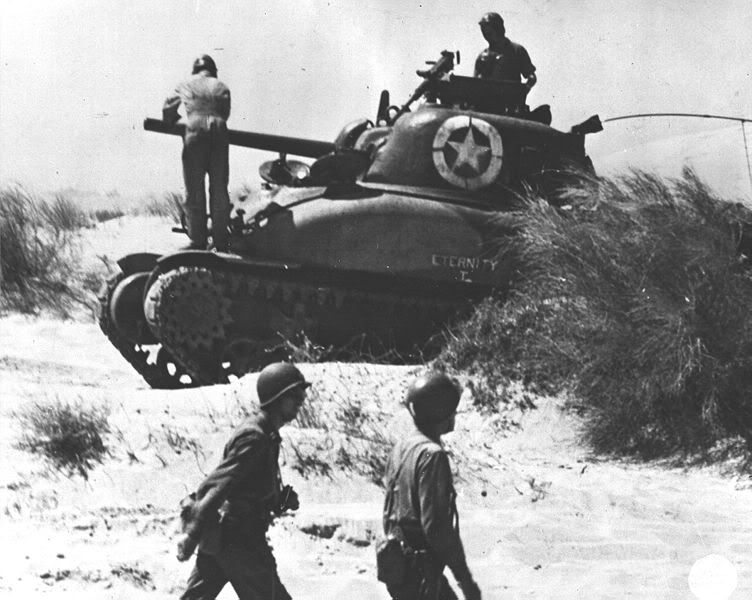
Just as the United States was stunned and united by 9/11, so was the America of 1941 stunned and united by Pearl Harbor. (Robinson) British tank men was a propaganda picture used to inspire Americans to stay committed to the war effort. It was intended to create a sense of national pride, in the same sense pictures of Americans fighting in Afghanistan did after 9/11. However, to the modern viewer, the key elements in British tank men do not inspire pride. Instead, they create a pathos of disappointment. American tanks during WWII were in fact far inferior to German tanks. Sights such as the picture to the left (an M4 Sherman) were all too common. The M3 was slow and was an extremely easy target for experienced Panzer gunners. It is true the M3 had some initial succes. (militaryfactory.com) However, the M4 tank, America's main battle tank, was sadly overmatched. (Dugdale-Pointon) Because of how well known it is, the M4 has come to symbolize American tanks during WWII. Thus, pictures that show American tanks bring to mind these failures and generate a pathos of despair.

In its original context, British tank men gave American civilians a sense of national pride and determination through vectors of attention, saturation, and framing. The picture of the M3 and the American teaching the British would have stirred nationalism, while the gritty feel gained through saturation would have inspired determination to win the war. To the 21st century viewer, the emotions brought forth are instead feelings of sadness and disappointment because of America's inferior tanks. World War II was the largest war in the history of the world, taking more lives than any war in history. Through this one small snapshot of that war, we can see the determination and pride Americans took in their military and country, and we are inspired to feel the same for 21st century America.

Works Cited:

Hickman, Kennedy, About.com, “World War I: General John J. Pershing.” © 2010. Author’s credential found here.

United States Memorial Holocaust Museum, “Blitzkreig (Lightning War)” Last updated May 4, 2009. © United States Holocaust Memorial Museum, Washington, DC.

Staff Writer, miliartyfactory.com, "Medium Tank, M3 (Lee / Grant)", (c) 2003-2010

Dugdale-Pointon, TDP. 16 November 2000, "M4 Sherman tank (1941)"

Robinson, Bruce, “Pearl Harbor: A Rude Awakening,” BBC. Last updated November 5, 2009.

Wednesday, March 3, 2010

WP #1 Rough Draft #2

For the first time the United States was involved in a full scale desert war. After the sneak attack on Pearl Harbor, the United States declared war on the Axis powers and moved to invade German North Africa. It was in this environment a wartime photographer took British tank men study U.S. tanks between battle in Egypt. British tank crews in Egypt train for the use of tanks arriving for the U.S.A. Experts on the U.S. machine give impromptu lessons, then the men climb aboard and examine every detail themselves. A gunner giving a talk on the 75mm gun (otherwise known as British tank men).

In order to understand the arguments made in this photograph, it is important to be familiar with its historical context. World War II began in Europe, and it was the first war to utilize the modern tank. The German military swept through Poland, the Netherlands, Belgium, and France in a very short time using a new strategy known as the blitzkrieg (lighting war), in which the Germans used their overpowering Panzer tanks to brush away any resistance. By 1941, this tactic had allowed Germany to annex or conquer all of continental Europe, and the Allies had no answer for the might of the Panzer. This trend continued in North Africa. The allies could not match the power of the German’s tanks. That is where the tank pictured in British tank men, the M3 Lee, came in. It was supposed to be able to match the firepower of its German counterparts. At the time, the M3 was the most powerful land weapon the Allies possessed. Thus, the M3 shown in British tank men would have a strong nationalistic appeal to the American viewer.

British tank men was not meant to be a documentary photograph, but a propaganda photograph used to boost the spirits of American civilians. This can be seen through the pathos and logos generated from the vectors of attention, saturation, and framing, inspiring feelings of nationalism and reflecting the belief of American superiority. However, to the modern viewer, those same technical elements speak of sadness and disappointment.

The first and most important element used by the photographer in British tank men is vectors of attention. When the viewer first sees this photograph, his eyes are immediately drawn to the tank (an M3 Lee), the focal point of the picture. At the time, the unprepared-ness of Pearl Harbor was still very much on the minds of Americans of this period. The M3 was the height of American military might and design. By making this monument to the power of the United States the main focus of the picture, the photograph reminded its original viewers that the US was had the capability to win the war. The state of the military at Pearl Harbor was no longer the case. Through the picturing of the greatest American weapon of war, Americans were reminded of their nation’s might, and inspired to work toward victory.

After the tank, the viewer’s attention is drawn to the actual soldiers in the picture. The vectors of attention of the soldiers are extremely important to the argument this photograph was making to American civilians. The British soldiers in the picture are obviously not looking at the camera, but are instead looking toward their American instructor. By situating the American at the head of the semicircle and showing the British soldiers learning from him, the photograph is once again appealing to the nationalism of Americans. The United States and Britain, despite being allies, had not always worked well together in war. In WWI, the British attempted to dismantle the US Army units shipped to Europe and instead use American soldiers as replacements for fallen British troops. To a lesser extend, British pride showed itself in WWII as well. The British had been fighting the Germans for four years across Europe, while the United States did not join until provoked by Japan. British arrogance did not take long to show itself once again in WWII. The vectors of attention show otherwise, reminding Americans and the world of American ingenuity. It is not the British who are teaching the Americans, but the Americans who are teaching the British how to fight the Germans. The logos of the vectors of attention of the British soldiers appeal to a pathos of nationalism and determination. Yet, while most of the British are looking at the American, one soldier is looking directly at the camera. He seems to be looking at the audience, reminding them the war is very real. This helps to draw the audience into the picture, and even gives the audience a feeling of sympathy for the soldiers. This would reinforce the appeals to Americans’ resolve in “getting the boys home.”


Finally, the American soldier is not shown looking at his students or the tank. He is instead looking at the shell in his hands. He sees that it is the most important thing to both him and his students. They have all most likely seen combat before, and seen the destruction the Panzers could cause. This shell could save his life, destroying the Panzer before the Panzer destroys him. Including this in the picture not only appeals to nationalism, but reminds the American people of the horrors of war. People will die on both sides, but the ingenuity and might (shown through the tank and the shell) of the Allies would win in the end.

This picture was taken in North Africa during spring or summer with a 1940s black and white camera. Therefore, the coloration is slightly altered by the limitations of period technology. However, there are specific elements within British tank men which could not be unintentional. These two purposeful elements are saturation and contrast. The photograph is super-saturated. In fact, it is so saturated that the background appears completely white. Usually, high saturation creates a dreamlike quality. In this case it does not. This creates harsh and sometimes hard to distinguish transitions between the tank, men, and shell. This gives the picture somewhat of a gritty, chaotic feel, creating a sense of chaos and confusion in the viewer. This forces the audience to focus on key objects, such as the tank, soldiers, and shell. Thus, it calms the audience while simultaneously making an argument of nationalism and determination by focusing attention on the objects making the argument.

Finally, British tank men is framed to specifically show a very narrow field of vision. No tank would be alone during wartime, especially “in between battles,” as the picture’s title says. However, the photographer chose to intentionally omit anything but the tank and soldiers. In addition, the field of vision specifically includes the armament and turret of the tank. The framing makes the tank the main focus of the photograph, thus appealing once again to the national pride Americans took in their technological prowess. In addition, the decision to show almost no sky and foreground suggests the surroundings of the photograph were not particularly important. While the picture was taken in the North African desert, the photographer does not want us to focus on the location, but on the soldiers (appealing to determination to win and bring them home) and the tank (sparking a pathos of nationalism).

Just as the United States was stunned and united by 9/11, so was the America of 1941 stunned and united by Pearl Harbor. British tank men was a propaganda picture used to inspire Americans to stay committed to the war effort. It was intended to create a sense of national pride, in the same sense pictures of Americans fighting in Afghanistan did after 9/11. However, to the modern viewer, the key elements in British tank men do not inspire pride. Instead, they create a pathos of disappointment. American tanks during WWII were in fact far inferior to German tanks, and the M3 Lee was no exception. Sights such as the picture to the left (an M4 Sherman) were all too common. The shell the American is staring at was fired from a low-velocity canon, which could not pierce the Panzer’s frontal armor. The British were learning how to fight in a moving deathtrap. The tank itself was slow and was an extremely easy target for experienced Panzer gunners. Essentially, the very elements that once inspired patriotism now inspire remind Americans of the death resulting from inferior technology.

In its original context, British tank men gave American civilians a sense of national pride and determination through vectors of attention, saturation, and framing. To the 21st century viewer, the vectors of intention instead inspire a pathos of sadness and mourning. World War II was the largest war in the history of the world, taking more lives than any war in history. Through this one small snapshot of that war, we can see the determination and pride Americans took in their military and country. Regardless of political ideology, the modern American can learn from the pathos shown in British tank men and be reminded that the freedom we enjoy came at a price, and that price is still being paid.